November 1, 2026 | VibeCoding Newsletter
The real money in vibe coding is inside businesses, not where you can see it
Welcome / Editorial
From the editor's desk
Hey all,
I'm the moderator of this r/vibecodingcommunity subreddit, and I've been involved in the vibecoding scene both online and offline - hosting dozens of hackathons and joining many events.
Here's my two cents on where the money is and the current state of vibecoding, from my lens (unfiltered).
1. Most builds aren't serious businesses
Around 70% of vibe-coded app builds are not serious business apps. They're fun games or personal software. Some try to build a product, but it dies almost as quickly as it's built - no distribution strategy, tokens burned in the process.
2. The rise of personalized, internal software
Vibecoding has significantly lowered the barrier to entry, so more and more personalized software has emerged. The next ~25% are internal apps - meant to replace software you already pay for, automate a workflow, or run an agency.
These are pretty much built by people who know one area of tech and use AI to compensate in the others. For example: a data scientist building a mobile app, or a front-end developer building a backend.
3. The 5% where the money actually is
This remaining 5% is the interesting part - because that's where the money is. These are people who already have a relationship with a business, or with internal players and vendors. They use vibecoding as a tool to pitch an idea, get traction or a contract, and then build.
Previously these people pitched on PowerPoint. Now that's been replaced by a simple vibe-coded app that demonstrates the idea.
A few real examples from just the last couple of weeks:
- We helped someone who had sold a fairly basic sales-analytics platform for around $200K. He came to us to build the proper software from the ground up.
- An existing entrepreneur - who has run 100+ franchise stores in the past - raised €2 million just by showing the vibe-coded idea. He already had a great track record; he just needed the funds to build his next business, and he wants us to make the software more polished.
- An employee at an 8-person business built an internal tool using Base44. He's from a non-technical background. They didn't pay us to build the software - they'll build it themselves - they hired us to scaffold a harness, review their work, and give them direction. They're using this internal tool across many franchises, and passing a share of the profit on to us.
The takeaway
All I'm trying to say is this: on the community you see people building a lot of software and tools. A real software developer quickly clocks that these are vibe-coded apps - not much taste, questionable software quality, often useless. And that's true.
But the real money is not where you can see it. The real money is inside businesses, and it's often being put to work by people who already have the network and the connections to make it count.
Viral Community Buzz
Who maintains all those vibe-coded tools?
Klaas (@forgebitz) posted on October 30 about having no time to maintain all those vibe-coded tools, and asked for a business model where someone else maintains the code for a monthly fee. The post had passed 568,000 views when this screenshot was taken.
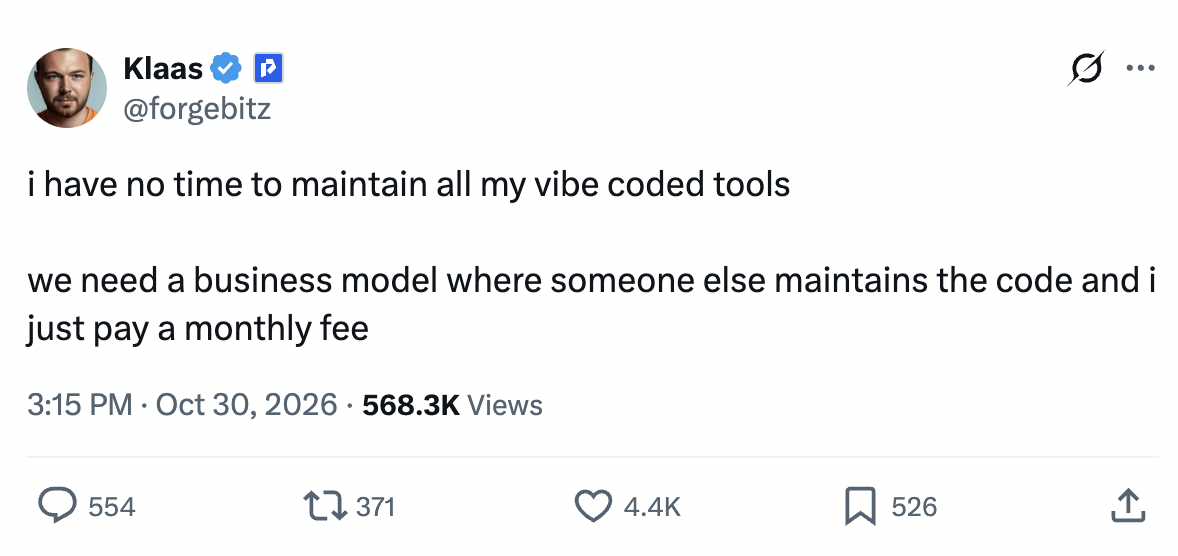
Image: Klaas on X.
That business model already exists. It is called SaaS, which is why the post landed. In our last edition we covered Pieter Levels cancelling most of his subscriptions in favor of self-built replacements. This post is the other side of that trade: a tool is quick to generate, but updates, broken integrations and bug reports keep arriving for as long as you use it.
Before you replace a paid tool, ask who fixes it six months from now. If the answer is you, count those hours in the price. The third example in this week's editorial points to another option: keep building the software yourself, and pay someone to set up the harness and review the work.
A designer learned to code by prompting until it worked
Vercel CEO Guillermo Rauch (@rauchg) wrote this in August 2025, after contacting a designer who had shipped an app Rauch admired. The designer had spent the previous two years learning to code by "hammering prompts into ChatGPT" until something worked. Rauch's conclusion was that vibe coding is now a way to start a successful career.
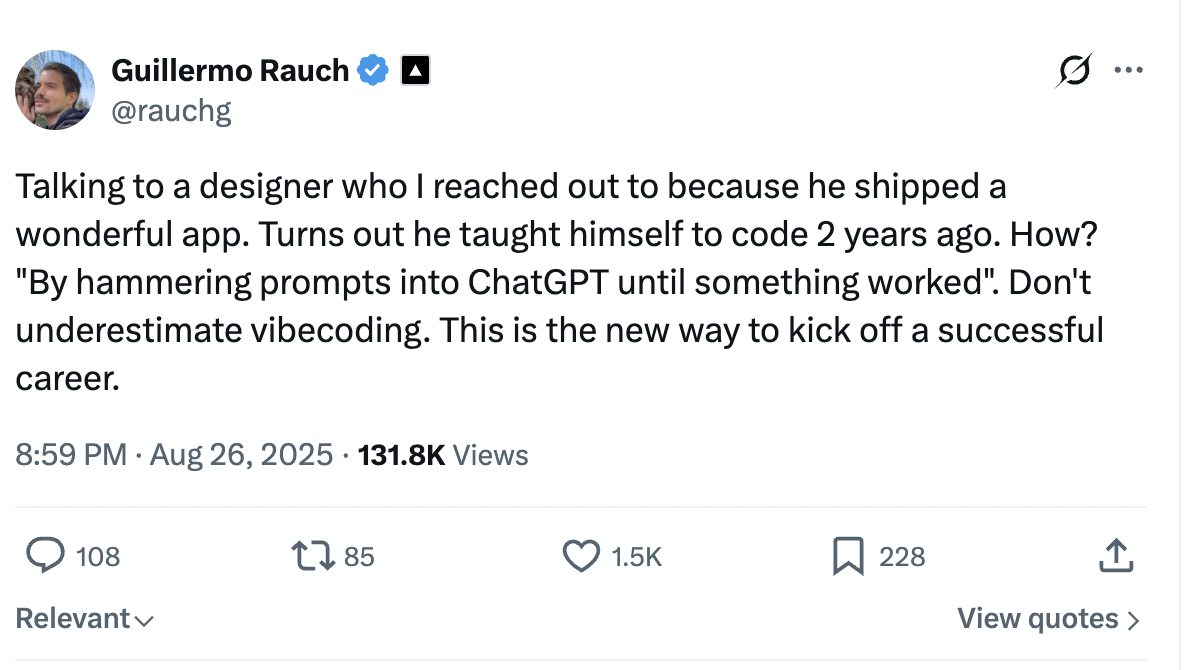
Image: Guillermo Rauch on X.
The post is more than a year old, and it fits the second group in this week's editorial: people who know one area and use AI to cover the others. Keep two things in mind. Rauch's company makes v0, an AI app builder, so this is not a neutral view. And the person in the story was already a designer, so the judgment that made the app good did not come from the prompts.
News & Updates
A tampered Claude Code extension reached Cursor's marketplace
On October 29, from about 2:27am to 1:35pm PT, Cursor's marketplace served modified versions of the Claude Code extension (2.1.312 and 2.1.313) for Windows and macOS. Cursor says at most 5,000 users were affected and that Anthropic did not build these versions. Microsoft says they never reached the Visual Studio Marketplace or npm. Cursor has not said how the package got into its marketplace.
The extension sent out host details and the names (not the values) of environment variables, added an SSH key labeled svc-telemetry, and tried to open a reverse tunnel to the attacker's server. Cursor says the tunnel generally failed without admin rights and that the server is now offline, but the key and the persistence were still installed.
What to do. If you use this extension in Cursor, check your authorized_keys file for svc-telemetry and follow Cursor's security notice, which has the commands and cleanup scripts. Uninstalling the extension alone may not be enough. Update to 2.1.314 or later, and rotate the credentials and sessions reachable from that machine, working from a trusted computer.
Epic says its engineers no longer write the bulk of the code
Epic released a rebuilt Epic Games Launcher in Preview on October 14, for Windows, macOS and, for the first time, Linux, and said it was vibe coded. Late in the month, executive VP of development Marcus Wassmer went further: Epic's engineers no longer write the bulk of the code, and they guide tools such as Claude Code and Codex toward the architecture they want. Wassmer's example is a rewrite of part of the D3D12 rendering layer, estimated at three to six weeks for one engineer, that took about a week.
Epic's claims need context. Its launcher benchmark, 5.47 seconds against 10.07 for Steam, came from tests Keywords Studios ran for Epic, with the three lowest-end of 16 machines left out. Epic itself says the first release is light on features, and Engadget criticized the messaging given Epic's layoffs of about 1,000 people in March.
For builders, the lesson is the workflow, not the label. Engineers still own the architecture and the performance limits, and they iterate with the tools. In Wassmer's words: "We're not 'one-shotting' the engine."
Simon Willison calls October a turning point for vibe-coded games
Developer Simon Willison argues that October 2026 did for vibe-coded games what November 2025 did for coding agents: models can now make games that are fun to play, not just games that look like one. Most of Willison's recent projects used Claude Opus 5.5, including Battle Drones, a real-time strategy game with multiplayer and a mode where language models fight each other.
Willison says the hard part has moved to coming up with novel concepts. There are caveats: the comparison with GPT-6 is informal, one of the games needed substantial playtesting to fix bugs, and Willison expects the community to split over games whose code, art, music and writing all come from a model.
Meme of the Week
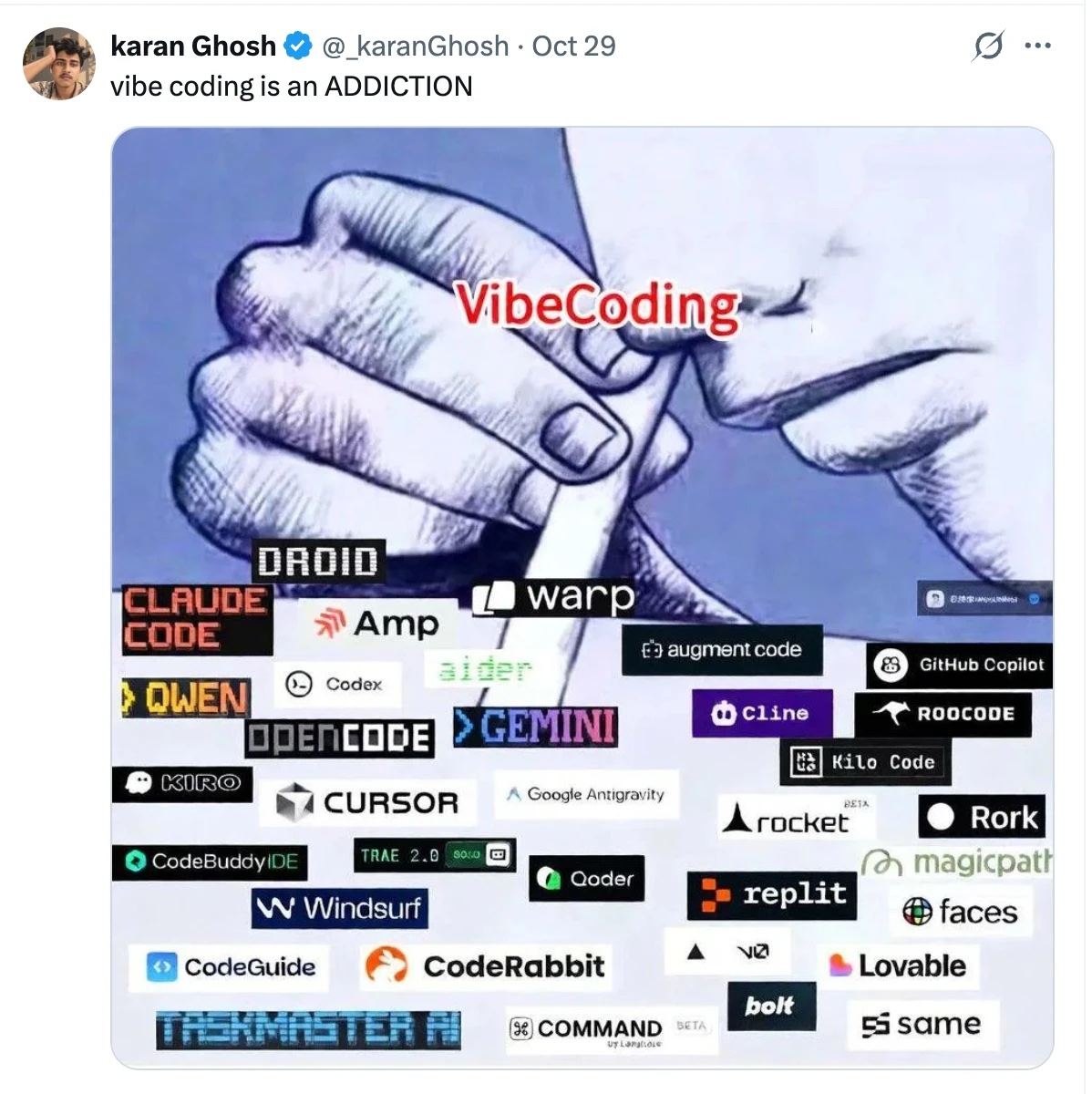
Image: karan Ghosh on X, captioned "vibe coding is an ADDICTION."
Count the logos: more than 30 tools in one picture. Funny because the habit is real, and every new tool is one more project someone has to maintain.
Building something worth sharing? Post it in r/vibecodingcommunity, or submit it to VibeCoding Newsletter.